Choosing the right lowbed trailer is not simply a matter of selecting the number of axles. The correct configuration depends on the weight and dimensions of the cargo, axle load regulations, road conditions, maneuverability, and the type of heavy equipment you need to transport.
For construction companies, mining companies, heavy haulage operators and equipment dealers, understanding the difference between 3 axle, 4 axle and 5 axle lowbed trailers can help reduce operating costs and improve transport safety.
What Is a Lowbed TraIler?
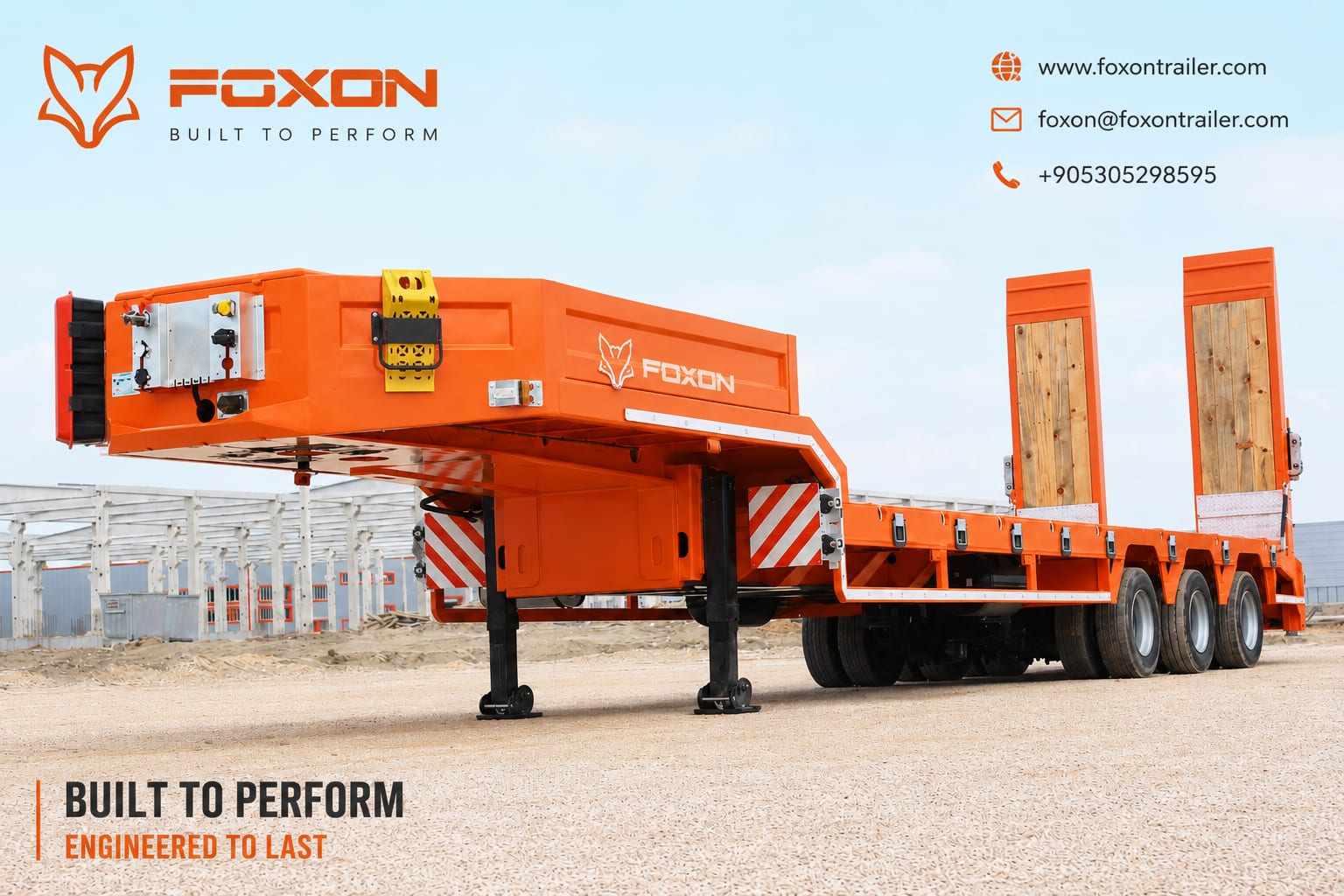
A lowbed trailer is a heavy-duty semi-trailer designed to transport construction machinery, mining equipment, agricultural machinery, industrial equipment and other oversized or heavy loads.
Its low loading height allows equipment such as excavators, bulldozers, wheel loaders and other tracked machinery to be loaded safely using ramps.
Foxon Trailer manufactures configurable lowbed trailers with different axle configurations, platform dimensions, suspension systems and loading solutions for international markets.
3 Axle Lowbed TraIler
A 3 axle lowbed trailer is one of the most commonly used configurations for general heavy equipment transportation.
It offers a good balance between payload capacity, maneuverability and operating cost.
Foxon's 3-Axle Lowbed has a 9.5 m deck and a maximum payload of up to 60,000 kg in its standard configuration. The platform can also be customized according to the cargo and project requirements.
For more information, see our 3-Axle Lowbed product page.
When should you choose a 3 axle lowbed?
A 3 axle lowbed can be a suitable choice when:
- The cargo weight is within the permitted axle-load limits
- You regularly transport excavators and construction machinery
- Maneuverability is important
- You want a lower operating and maintenance cost
- The trailer will be used for general heavy haul applications
For many construction companies, a 3 axle configuration provides an effective balance between capacity and flexibility.
4 Axle Lowbed TraIler
A 4 axle lowbed trailer provides additional load distribution compared with a 3 axle configuration.
This makes it suitable for heavier machinery and applications where axle load distribution is particularly important.
Foxon's 4-Axle Lowbed features a 9.5 m deck, up to 150-ton load capacity depending on configuration, and a 900 mm loading height.
The trailer can be configured with different axle, suspension, ramp and steering options depending on the customer's requirements.
When should you choose a 4 axle lowbed?
A 4 axle configuration may be preferable when:
- The cargo is heavier than a typical 3 axle application
- Better load distribution is required
- National axle-load regulations require additional axles
- You regularly transport heavy construction or industrial machinery
- The project requires a higher-capacity lowbed
See the 4-Axle Lowbed product page for detailed specifications.
5 Axle Lowbed TraIler
A 5 axle lowbed trailer is designed for particularly heavy and oversized transportation requirements.
Adding another axle can improve load distribution and allow the trailer to be configured for demanding heavy-haul applications.
Foxon's 5-Axle Lowbed has a 9.5 m deck, 900 mm loading height and a configurable capacity of up to 150 tons depending on the chassis and axle configuration.
When should you choose a 5 axle lowbed?
A 5 axle lowbed may be the better solution when:
- The cargo is extremely heavy
- Axle load distribution is critical
- You transport large mining or industrial machinery
- The project requires a high-capacity heavy haul trailer
- Local regulations require a greater number of axles
See the 5-Axle Lowbed product page for detailed specifications.
3 Axle vs 4 Axle vs 5 Axle Lowbed: ComparIson
| Feature3 Axle4 Axle5 Axle | |||
| Typical application | General heavy equipment | Heavy machinery | Very heavy / oversized machinery |
| Maneuverability | Very good | Good | Good |
| Load distribution | Good | Better | Excellent |
| Operating cost | Lower | Medium | Higher |
| Heavy-haul capability | High | Very high | Maximum |
| Best for | Construction equipment | Heavy industrial equipment | Mining and extreme heavy haul |
The exact payload should always be determined according to the trailer configuration, axle capacity, cargo dimensions and applicable road regulations.
Axle CapacIty Is Not the Same as Payload
One important point when comparing lowbed trailers is that the number of axles alone does not determine the legal payload.
Other factors include:
- Individual axle capacity
- Chassis design
- Suspension type
- Kingpin and fifth-wheel limitations
- Cargo position on the deck
- Road and bridge restrictions
- Local regulations
- Tractor capacity
For example, Foxon's configurable lowbed platform supports different axle and chassis configurations, with individual axle capacity options depending on the required specification.
Therefore, a professional manufacturer should calculate the complete combination rather than simply recommending more axles.
LoadIng HeIght Matters
Loading height is another important factor when selecting a lowbed.
A lower deck can provide additional clearance for tall construction machinery and help keep the overall vehicle height within legal limits.
Foxon's 4 axle and 5 axle lowbed configurations have a listed loading height of approximately 900 mm, while the 3 axle extendable model has an 860 mm loading height.
The appropriate loading height should be selected according to the dimensions of the equipment being transported.
What About an Extendable Lowbed?
Axle configuration is only one part of the decision.
If the cargo is particularly long, an extendable lowbed trailer may be more appropriate than simply adding axles.
Foxon's 3-Axle Extendable model has a deck length of 13.6–21 m and a telescopic extension range of 4–15 m.
It can be used for long loads such as:
- Wind turbine components
- Long steel profiles
- Rails
- Structural equipment
- Oversized industrial components
For long cargo, see Foxon's 3-Axle Extendable Lowbed.
How to Choose the RIght Axle ConfIguratIon
Before ordering a lowbed trailer, consider these six questions:
1. How heavy is the cargo?
Start with the actual operating weight of the machinery or equipment.
2. What are the cargo dimensions?
Length, width and height can be just as important as weight.
3. What are the local axle-load regulations?
A trailer suitable for one country may require a different axle configuration in another country.
4. What roads will the trailer use?
Mining sites, construction sites and public highways can have very different requirements.
5. How often will the trailer carry maximum loads?
If maximum-capacity transport is occasional, a flexible configuration may be more economical than a permanently heavy specification.
6. Do you need an extendable platform?
For long cargo, an extendable lowbed can provide significantly more flexibility.
Why Work WIth a TurkIsh Lowbed TraIler Manufacturer?
Turkey has become an important manufacturing base for semi-trailers serving European, Middle Eastern, African and other international markets.
When comparing Turkish lowbed manufacturers, buyers should look beyond the purchase price.
Important factors include:
- Chassis engineering
- Axle and suspension options
- Brake systems
- Welding quality
- Steel selection
- Spare parts availability
- Export experience
- After-sales support
- Customization capability
- Compliance with the destination market
A detailed guide to selecting a manufacturer can be found in our article How to Choose a Lowbed or Lowboy Trailer Manufacturer in Turkey.
You can also learn about the terminology differences between lowbed, lowboy and low loader trailers in our article Lowbed vs Lowboy vs Low Loader: What Is the Difference?
Why Choose Foxon TraIler?
Foxon Trailer is a Turkish semi-trailer manufacturer based in Konya, Türkiye.
The company produces configurable lowbed trailers for heavy equipment transportation and international markets.
Depending on the project, Foxon can provide different axle configurations, platform dimensions, ramp systems, suspension options, brake systems and other technical specifications.
The objective is not simply to supply a trailer with more axles, but to design the correct trailer configuration for the customer's cargo and operating conditions.
Frequently Asked QuestIons
Is a 3 axle lowbed enough for an excavator?
For many excavators and construction machines, a 3 axle lowbed can be suitable. The correct configuration depends on the machine's actual weight, dimensions and applicable axle-load regulations.
Is a 4 axle lowbed better than a 3 axle lowbed?
Not necessarily. A 4 axle trailer can provide better load distribution and higher capacity for demanding applications, but a 3 axle trailer may be more economical and maneuverable for lighter loads.
When do I need a 5 axle lowbed?
A 5 axle configuration is generally considered when transporting very heavy or oversized machinery and when additional load distribution is required.
Does more axles always mean more payload?
No. Legal payload depends on the complete trailer and vehicle combination, axle capacities, road regulations, cargo positioning and other technical factors.
Is an extendable lowbed better for long cargo?
Yes, when cargo length is the main challenge. An extendable lowbed allows the deck to be lengthened for long loads while maintaining the required support and stability.
ConclusIon
There is no single lowbed trailer configuration that is ideal for every application.
A 3 axle lowbed can be an excellent solution for general heavy equipment transportation. A 4 axle lowbed can provide improved load distribution for heavier machinery, while a 5 axle lowbed is suitable for demanding heavy-haul applications.
If cargo length is the main challenge, an extendable lowbed may be the better solution.
The most important step is to match the trailer configuration to the cargo weight, dimensions, axle-load regulations and operating conditions.
If you are looking for a 3 axle, 4 axle, 5 axle or extendable lowbed trailer from a Turkish manufacturer, contact Foxon Trailer for a project-specific configuration and quotation.